
Bathroom Renovation Preview: 12 Looks, 1 Photo
· 7 min read
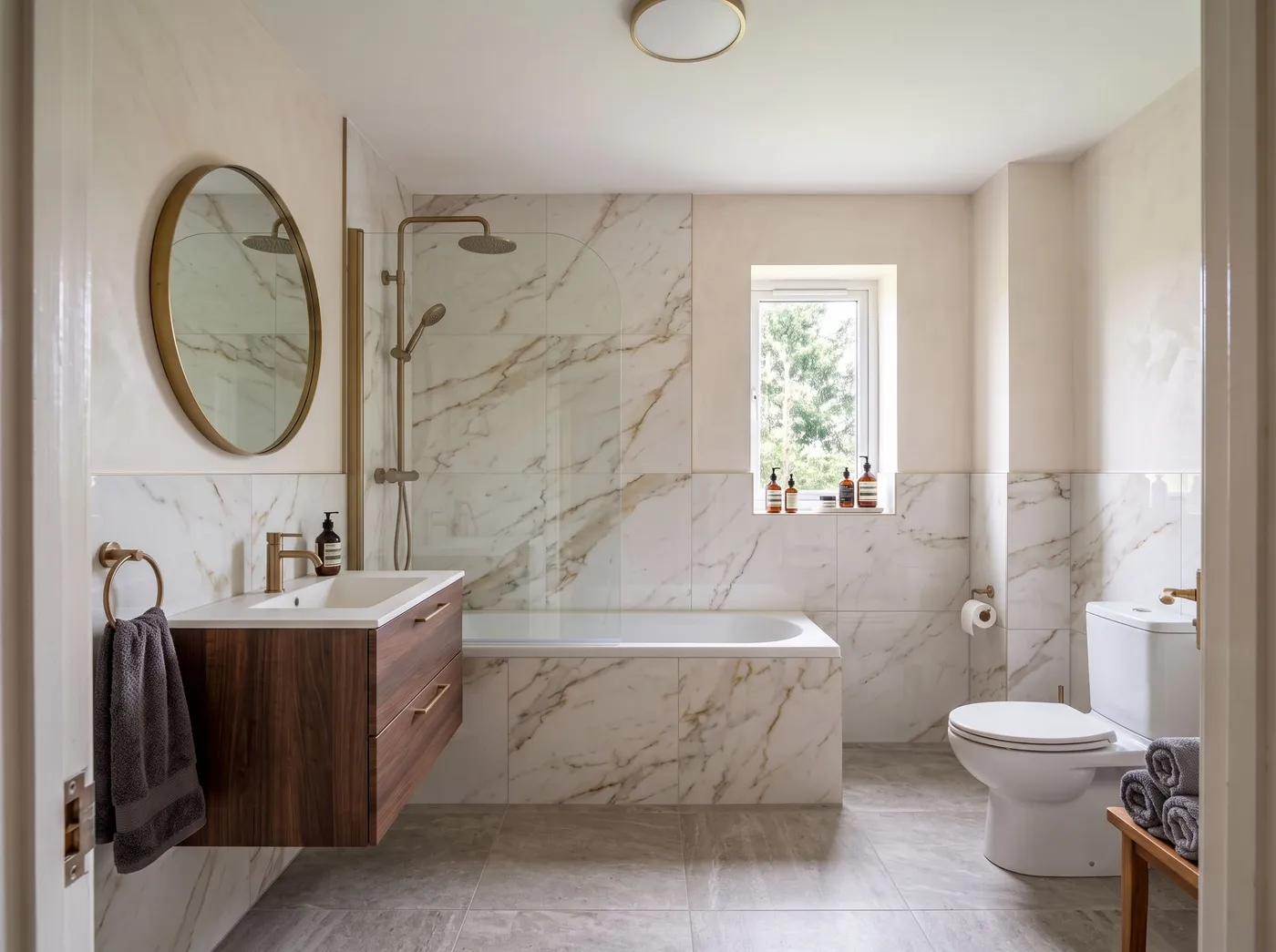
Tile samples lie by omission. A 10×10 cm square of grey stone under showroom lighting tells you nothing about how it reads against your actual grout lines, your actual window, your actual towel rail. Bathroom remodel AI skips the sample stage entirely: upload one photo of the bathroom you have, and get back the same room wearing twelve different real finish directions — tile, vanity, shower, taps, lighting — so the comparison happens on your walls, not a display board.
The mechanism is the same one behind the other remodel pages on this site: the tool runs on Interior AI with the room type set to Bathroom, and it reads only the photo you upload. Your camera angle, your window position and your room's proportions carry over into every version; what changes between runs is the finish — which is exactly the part a sample tile can't show you in context.
What makes a bathroom worth testing this way more than most rooms is how little room for error it has. A kitchen has enough square footage that a slightly-off cabinet color can hide among the rest of the room. A small bathroom is four finishes — floor, wall, vanity, fixtures — seen all at once from the doorway, which is also why previewing the remodel before ordering anything saves more in a bathroom than almost anywhere else in the house.
The 12 looks, and what each one actually changes
These aren't mood-board labels invented for this post — they're the same style presets the tool ships with, applied with a bathroom brief (tile, vanity, shower glass, brassware) instead of a generic one:
- Modern Luxury: large-format marble-look tile, a floating vanity with a stone top, gold or brushed-brass fixtures, layered lighting.
- Minimal: flat matte tile in one or two tones, a wall-hung vanity with no visible hardware, everything else deliberately absent.
- Japandi: pale timber vanity, soft stone tile, a low-profile tub, warm diffused light instead of a single overhead bulb.
- Scandinavian: white walls, light oak vanity, matte black taps, a bright even wash of light across the whole room.
- Industrial: dark zellige or subway tile, exposed black fixtures, a concrete-look floor, a single filament pendant.
- Mid-Century: warm walnut vanity, geometric floor tile, brass accents, a round mirror instead of a medicine cabinet.
- Mediterranean: plaster-finish walls, terracotta or zellige tile, a freestanding stone basin, warm afternoon light.
- Classic: metro tile with a contrast grout line, a furniture-style vanity, polished nickel hardware, a framed mirror.
- Rustic: raw timber shelving, stone-look tile, a freestanding tub, taps with visible pipework.
- Art Deco: black-and-white geometric floor, brass trim, a fan-shaped mirror, a shell-shaped basin.
- Bohemian: patterned encaustic-style tile, a reclaimed-wood vanity, woven textures, plants where the floor space allows.
- Futuristic: glossy large-format panels, backlit mirror, concealed fixtures, cool ambient LED lighting.
Running all twelve takes roughly the same time per look as trying three — about 30 seconds each — which is the actual point. Three directions is a guess at what you might like; twelve is a genuine comparison, and the two or three that survive looking at your own doorway and window are the only ones worth taking to a fitter.
Running the comparison
- Photograph the bathroom as it is. From the doorway or a corner, lights on, the whole room in frame. A wide-angle phone lens helps in a small room.
- Upload it once. Room type Bathroom, then work through the style presets one at a time, or describe your own direction in a sentence if none of the twelve quite fits.
- Let each render land before judging it. A style that looks wrong as a thumbnail can read completely differently full-size against your actual tile layout.
- Shortlist two, not twelve. Send the finalists to whoever else is paying for the renovation, or straight to a fitter for a quote on the direction you've actually agreed on.
What this does and doesn't settle
It settles the look — usually the argument that stalls a renovation before it starts, since "something modern but warm" means a different room to everyone in the house. It does not settle a quote, a fixture schedule, or whether your plumbing stack can take a freestanding tub where a built-in one used to be. Treat every render as a photoreal mood board, not a measured drawing.
Frequently asked
Do I have to try all twelve styles? No — run however many you want. Twelve just happens to be how many the tool ships with, and trying more than two or three is usually what reveals the one that actually fits your room's light and layout.
Will the layout change between styles? It shouldn't — the photo anchors the walls, window and camera angle across every version. Compare each result against your original to confirm it held.
Can I mix elements from two styles I liked? Yes, by describing the combination in your own words instead of picking a preset — "Scandinavian walls with Art Deco floor tile" works as a prompt on its own.
Is it free to try? Yes. A new account gets a one-time 100-credit trial with no card required, which covers three renders — enough to compare a handful of these directions on your own bathroom.
Stop guessing from a tile sample. Upload a photo of your bathroom and see it in twelve finishes before you order one — free to try.