
AI Front Yard Landscaping Ideas
5 min read
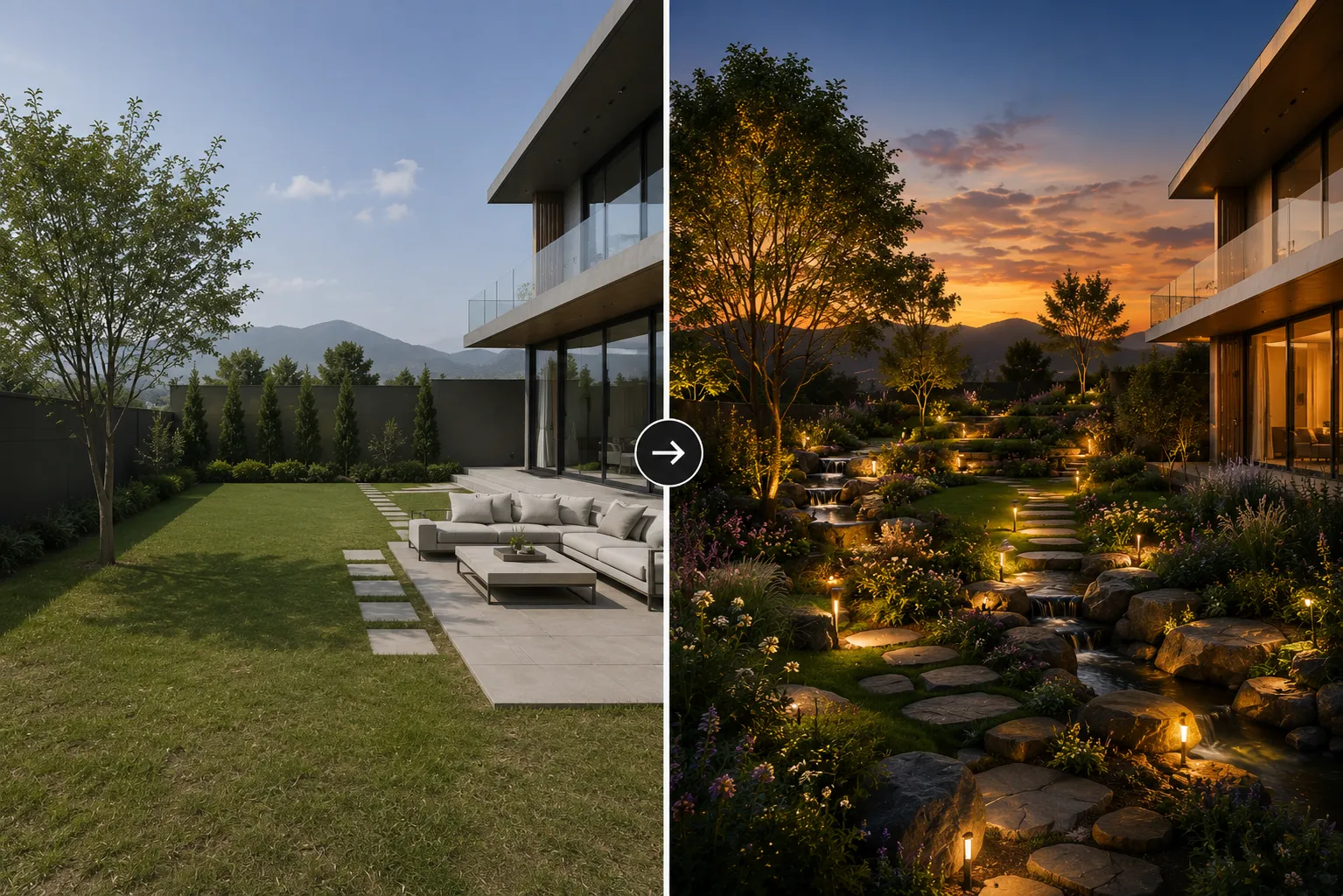
The front yard is the one part of a property everyone sees and almost no one plans properly — it is usually whatever the builder left behind: a strip of lawn, a foundation hedge, a straight concrete path to the door. Redesigning it well used to mean hiring a landscape designer for a plan you could not really picture until the plants were already in the ground. AI shortens that to seconds: upload a photo of the front yard as it is, describe the direction, and see the same yard — same boundaries, same driveway, same path — redesigned with new planting, paving and structure.
How it works
- Photograph the front yard from the street or the end of the driveway, in daylight, with as much of the yard in frame as possible.
- Upload it to Landscape AI.
- Describe the direction — planting style, paving material, and anything you want kept or removed.
- Generate a few alternatives and compare them side by side against the original photo.
The model reads the fixed elements already in the shot — the driveway edge, the entry path, the property line, the house facade itself — and holds those in place while it replaces what sits on top: lawn, beds, shrubs, mulch, edging and lighting.
Front yard prompts worth trying
- Low-maintenance modern: "gravel bed planting, ornamental grasses, clipped low hedge along the path, steel edging, minimal lawn" — the direction most requested by owners tired of mowing.
- Cottage approach: "informal mixed perennial border, curved stepping-stone path, low picket edge, climbing rose by the door".
- Drought-tolerant / xeriscape: "native drought-tolerant planting, decomposed granite path, boulders as accents, no turf" — useful for testing whether removing the lawn entirely still looks intentional rather than bare.
- Formal entry: "symmetrical clipped boxwood either side of the door, straight paver path, uplighting on the facade".
Run two or three of these on the same photo rather than one — planting style and path material are usually the real open questions, and small wording changes shift both noticeably. (New to prompting rooms and exteriors generally? The AI interior design guide covers the fundamentals that carry over.)
What a front yard redesign actually needs to answer
Unlike a backyard, a front yard has to work with things you cannot move: the driveway width, the entry path position, the mailbox, and whatever sits directly under the windows. Naming these directly in the prompt gets a more useful result than a generic style word:
- Foundation planting: ask for species and height explicitly — "low evergreen shrubs under the windows, no plants taller than the sill" — otherwise the AI may place planting that would block light indoors.
- The path to the door: specify the material by name — "buff sandstone pavers", "brick in a herringbone pattern", "poured concrete with exposed aggregate" — since "nice path" defaults to whatever is most common in its training data, not your budget.
- Lawn vs. no lawn: say so directly — "keep the lawn, redesign only the beds" or "replace the lawn entirely with gravel and planting" — since this is usually the single biggest cost and maintenance decision in the whole redesign.
- HOA or local rules: the AI has no idea what your neighborhood allows, so keep the redesign within whatever constraints you already know apply before you fall in love with a version you cannot build.
Frequently asked
Does it keep my actual house and driveway? Yes — the facade, driveway edge and property boundaries stay exactly as photographed. Only the landscaping on top changes.
Can I test removing the lawn entirely? Yes, and it is one of the more common uses — seeing gravel or a mixed bed in place of turf on your actual yard makes the decision concrete instead of a guess from other people's photos.
Is this the same as backyard garden design? The tool is the same, but the constraints differ — a front yard has a fixed path and driveway and answers to curb appeal; a backyard is usually about layout and use. See the AI garden design guide for the backyard-focused version of this workflow.
What it won't do
The AI won't tell you whether a plant survives your climate zone, won't check local permit rules for hardscaping, and won't grade the site if drainage is a real problem — those need an actual landscaper or contractor. What it will do is answer the question most homeowners are stuck on before that call: what should this yard become, in enough visual detail to brief someone against, or to know before you start digging. If the rest of the exterior needs the same treatment, the AI curb appeal ideas guide covers paint, siding and lighting on the house itself, and AI facade design covers the building side of the same project.
Upload a photo of your front yard and see it redesigned in a few directions — first renders are free.